8.24.2011

A Word for Wednesday

Asperity - n [L. asperitas, from asper, rough]
                  1. Roughness of surface; unevenness; opposed to smoothness
                  2. Roughness of sound; that quality which grates the ear; harshness of 
                      pronunciation
                  3. Roughness to the taste; sourness
                  4. Roughness or ruggedness of temper; moroseness; sourness; crabbedness
                  5. Sharpness

Now here's a word you can use in a myriad of contexts. The range of application is in the very definition of it - three of the five senses are listed. That's highly unusual for a word, at least as far as I've discovered. Most words go with other words. The context and association are built in already and it's strange to hear them used outside of that box. Not so with asperity. It has engrained versatility, which makes it great fun to use.

I couldn't find a single lick of history about this word aside from the little "L. asperitas, from asper, rough]" that's noted in the dictionary entry. But that doesn't count. The wide expanse of the web was also devoid of any passages, literary or otherwise, from famous folks who'd used it in ages past. I can't find it in me to be disappointed though. It's a very useable word.

It doesn't sound like something out of  a Medieval castle or ancient text. It's pronouncable (which is always helpful). It's meaning can be explained quickly. And it can easily be incorporated into normal conversation without plastering a sign that says "I Am A Wordaholic" on one's forehead. Personally, I like wordaholics. Most wordaholics are either voracious readers, writers, or both and that means we have common ground. I understand, though, that an excessive love of abnormal vocabulary can be tedious for more normal people. That's why words like asperity were invented ;) They're bridge words. Wordaholics like using them and non-wordaholics don't mind hearing them.

And now to use it in a story...


"He was altogether out of place.

He almost appeared out of time.

His attire was most unusual. And he kept stealing glances over his shoulder and down the hallways, as if he was looking for someone. Or perhaps something. I followed him through the crowded parlor and into the antechamber, replying with the very minimum of courtesty to those who spoke to me as I passed. I saw him start down the stairs and slipped my shoes off, leaving my heels where their clack could not betray my presence.

It was so quiet below. All the lively sounds of the main rooms were muted, hushed enough to cover the movement of my gown as I stepped, but not loud enough to give life to the empty floor I soon reached. Where could he have vanished to? I took a few quick steps and peered down the hall that stretched out beneath the right wing of the house. It was empty. Lit and lovely, but empty. I dropped my skirts and turned to go back.

"Why do you follow me, madam?"

I caught my heart as it leapt to my throat at the drop of his voice.

He was leaning against the wall opposite me. Where had he come from?

"Truly, I find it most perplexing."

I swallowed, glad for strong, safe feeling of the wall at my back. "I meant no harm or insult, sir" I said. "I was only curious."

My voice sounded so frail and timid after his.

"Curious?"

There was an asperity in his laugh that matched the rest his appearance. The uneven lines of hair on his face. The grating sound that girded his voice. The sharp cast of his face.

"I would warn you against curiosty, my lady," he said.

"I'm afraid I do not understand your meaning."

He came toward me. "Pray that you never do."

Then he took my hand, raised it to his lips, and walked away without another word.

"Wait, who are you?" I called after him.

He kept walking.


8.17.2011

A Word for Wednesday

Amanuensis - n, [L. from manus, hand] A person whose employment is to write what another dictates.

Apparently, this word has it's origin in ancient Rome. It was first used to describe a slave who was at his master's personal service - 'within hand reach,' performing any command. The literal translation of the original Latin means "servant from the hand." Later, the application narrowed and the word was applied only to intimately trusted servants who served as personal secretaries to their masters.

It's most modern use seems to be in reference to or dealing with slavery in the United States. The Norton Anthology of African American Literature defines it this way: "Pertinent especially to exslaves' narratives of bondage in antebellum and postbellum United States. An amanuensis was a person who produced written accounts of orally narrated stories of black life in slavery. Some amanuenses completely reconstructed the life story of a formerly enslaved person; most proclaimed the resulting narrative to be a faithful depiction of the black narrator's story."

The Greenwood Encyclopedia of Multiethnic American Literature says, "The employment of an amanuensis was a way in which slaves could document their experiences by relating their stories to a person who would record and write down their narrative. However, since the slave narrating the story could not read what the amanuensis wrote, stories related by slaves could be edited or changed in order to cater to a specific audience or book publisher. Thus the employment of an amanuensis could ultimately complicate or call into question the truth of that experience."

Can you imagine being the one doing the dictating to an amanuensis? Whether you were a Roman master or a newly freed slave, you would be entrusting matters of import to someone who was effectively a stranger. Until the word's application evolved to applying to intimately trusted servants, all those Romans were dictating their communications to whichever slave could write. And they had to go forward on the assumption that their thoughts were accurately transmitted. Can you imagine dispatching something, from letter to manuscript, without verifying it's contents? Without even being capable of verifying the contents? They probably didn't even think about it. They probably just assumed that their slaves would do what they ought to do and that was it. It's easy to look back at history and see how much power amanuensis' had to manipulate events if they chose to. I wonder how many masters worried over that. And how many amanuensis thought to use their ability to write to undermine their masters. No doubt, there were slaves who loved their masters and would never think of betraying them. But I'm also sure that there were slaves who hated their masters and would use any means in their power to take measures into their own hands. Does it make you wonder? Or is it just me? I think it's fascinating, from both vantage points.

Now let's hope I can make that fascination at least somewhat productive...


"Britanicus."

That's all he ever said to summon me. My name. One word and I was to follow. So follow I did, promptly and without dropping my writing utensils on the way as I had done at the first.

It wasn't my true name. He didn't even know my true name. No one in the entire city did. He only knew three things about me: that I was a Britain, that I could write in Roman letters, and that I was his slave. And all those things were true. I was his amanuensis. But there are more than three things to any man, even, perhaps especially, an enslaved one.

He reached for the clasp on his cloak and I clambered to set up my parchment. Why the man could not pause a step before he began his oratory I still did not understand, but understanding the man was hardly required of me. Only my services were. He tossed his cloak aside as he took his stance; right hand on his hip, left foot out in front of his body, back straight, head high.

"To the Tribunal..." he began and I began to scribble, matching the scratch of my pen to the march of his voice.

8.12.2011

Oh Me, Oh My

My Merlin-musicals-and-peanut-butter buddy Jen has given me an award and tagged me in a meme. Because she's just that generous :) I'm not a cuddle-with-pets kind of girl, but if I was, I'd cuddle with my award. Look how soft and fluffy and cute it is:


Told ya ;) And now for the meme...


Show us the cutest most adorable picture of your favorite animal.


And just because I'm not sure that "cute" or "adorable" are appropriate adjectives for wolves, here's my other favorite animal:


You have five seconds to survive the Zombie Apocalypse. Choose one friend who would save your butt and tell us why you choose them.
Um. My sensei. He's a black belt in ten different martial arts and almost a brown belt in Gracie Jiu-Jitsu. I'm pretty sure he could handle the Zombies. Or...my little brother. He's biologically protected by the cuteness factor so I think my chances of survival with him would be really, really good.

Share a quote with us.

Oi. Quotes. You know those people who have all these wonderful, inspiring quotes plastered all over their rooms and in their journals? Yeah, I'm not one of them. I like the idea, I really do. The execution of such an idea, though, has been and is still elusive. But for you, I will find a worthy quote.

"Books are good company, in sad times and happy times, for books are people - people who have managed to stay alive by hiding between the covers of a book." E.B. White

I know you had trouble choosing just one, let's have another.

I'll do better than that. I'll give you two more but you have to guess who says the second one. Okay?

"It takes courage to grow up and turn out to be who you really are." e.e. cummings

And:

"You keep using that word, I do not think it means what you think it means."

Using exactly 27 words tell us your life story.
Born. 17 years in Upstate NY. Moved to KY. 18 months renovating home. Writing in between. Goal: English BA in 2 years. Graduate: December. Future: Writing + Jiu-Jitsu.

Please do not throw your hands up in the air. This is not a stick up.

Hands? What hands? I had to scratch my head.

All the dead rock legends live again. You're standing in a fifty mile long line for:

This would involve me knowing at least one rock legend....

Describe yourself using six words that start with the third letter of your middle name.

Sweet (I'm not being conceited, I promise. This is the most common way my friends describe me). Sincere. Scholarly. Steadfast. Sensible. Supercalifragilisticexpialidocious.

What is your middle name? (This is for research purposes only. Your response will not affect your chances of employment)

Rose.


There you have it. I guess the last thing is to pass it one, so I hereby dub the following people Memed:


8.10.2011

A Word for Wednesday

Someday I'm going to succeed in posting these posts during the morning on Wednesdays.

But today is not that day.

Today you get another one of my barely-counts-as-Wednesday posts. Consider it an act of social deviance, since I refuse am involuntarily incapable of posting during decent browsing hours ;) Anyway...


Alcanna n,  A plant; and a powder, prepared from the leaves of the Egyptian privet, used by the Turkish females to give a golden color to the nails and hair. Infused in water it forms a yellow color; with vinegar, it forms a red. From the berries is extracted an oil, used in medicine. In Cairo, it forms an article of commerce.

It's fancy botanical name is Lawsonia inermis. More commonly, it is known as the henna plant. In the Bible, it's referred to as camphire.In England, it's called Egyptian privet (which sounds far too much like Egyptian privy if you ask me), and in Jamaica it's called  mignonette.  It grows in Arabia, North Africa, Iran, and the East Indies.

Emedicinal had a whole page devoted to this plant. I'll give you the highlights, beginning with a history of it's use. "Few women of today realize that they are using an herb used by women in Cleopatra’s time and for thousands of years before in Egypt. The ladies of those remote times used Henna for dyeing their finger and toe nails also. Even the men used the herb for dyeing their beards and coloring the manes and tails of their horses. These methods were not approved of by other peoples according to this ancient writing which states in regards to captured ladies of the ancient civilization: “Then thou shalt bring her home, to thine house; and she shall shave her head and pare her nails.” So strong was the prejudice against dyeing hair that women of Europe did not use Henna until the very late 19th century. From the fashion centers of Vienna and Paris, the use of Henna spread rapidly over the world."

Another source (who I can't find again to link to, naturally) said this, which I found very interesting, "Ancient Egyptian mummies were found with nails, finger tips, palms, and soles dyed with henna. Records show that as long ago as 3200BCE, henna was mixed with indigo to make black hair dye."

And just in case you're wondering how dye is made from this plant: "The fine cut leaves or powdered leaves are made into a paste with hot water and applied to the hair and allowed to remain until the desired shade is obtained. On finger or toe nails the paste is allowed to remain over-night or paste is renewed often until the desired shade is obtained." Nice and easy and simple, right? Well, apparently folks in olden times had as much trouble with henna dye as we do with hair dye and tanning. "The old texts remind us that 'when dyeing (the hair), consider color of your eyebrows, complexion, etc., in order to get a harmonizing and natural appearance. Henna dye shows the color more after the second day of application.”

Clearly, this plant was used primarily as a dye. However, it also has/had a wide range of other uses, most of them medical. The lilac-scented oil is used in perfumery. The flowers act as an insecticide. A gargle can be made from the leaves and used internally or externally (for skin problems). As an astringent, it controls bleeding as well as being antiseptic and anti-bacterial. It can be used to treat diarrhea, amebic dysentery, liver problems, headaches, jaundice, leprosy, psoriasis, burns, ulcers, boils, wounds, and skin diseases. It's also an ingredient of eye lotions and anti-rheumatic liniments in the Middle East. How's that for a multi-purpose plant? My goodness. No wonder it was a valuable trade item.

Now that I've completely inundated you with information, I'll get to the story.


"Hurry with that, child," Zola said, pacing in front of me as if that would make the water boil faster. "You've been too long already. You know how she gets."

"No hurrying will make this water heat quicker," I said. I had already cut the alcanna leaves into slivers but bubbles hadn't even begun to form in the kettle.

"You'll get a lashing for this, and I'll share it with you most like."

"Zola." I pushed myself off the floor and took her firmly by the arms. "Calm yourself. The dye will be ready in moments. If the Sultana has us lashed for it, well, so be it. She's an impatient woman and I can only improve the appearance of imperfections, not remove them."

"Hush, child! Her eyes and ears are in every wall and curtain and cushion. If you would stay where you should be instead of running off, we would never have to worry for our backs."

"If I were to stay where I should all the time that I should, I would die of madness, dear Zola."

She threw her hands up and went back to pacing. I poured the water onto the leaves and watched the color bleed from them through the rising steam. I ground them together until the paste was right, then grabbed Zola's hand and dragged her with me towards the Sultana's chamber.


8.05.2011

It Almost Sounds like "Lobster"

But it's not. It's "liebster" and it means friend in German. It's also an award that was given to me. See?


It was given to me by K.V.Briar. She is personally responsible for at least my last three followers, so that little number over there that says "50 Followers," that's because of her :) This is my shout-out to her, with my thanks for the award and for introducing me to her own followers. Make sure you check out her blog! You can't go wrong with the woman who thinks in ink and who's mother to the Prince and Princess of Briar Castle.

There's no tell-us-seven-things rule to go along with this award. It's sole purpose is to connect bloggers, specifically those with less than 200 followers. Look how quick and simple these rules are:
  1. Show your thanks to the blogger who gave you the award by linking back to them.
  2. Reveal your top 5 picks and let them know by leaving a comment on their blog.
  3. Post the award on your blog.
  4. Bask in the love from the most supportive people on the internet—other writers.
  5. And best of all – have fun and spread the karma.
You know what's crazy? I had to go through the list of people I follow three times to find five bloggers who had less than 200 followers. So, these five people listed below are slow-and-steadiers like me whose blogs ought to have more traffic than they do because they're great.

1. Melissa
2. Ashley
3. Bluestocking
4. Krista
5. Christine

I'd spend more time talking about each of them, but my textbooks are calling me. With only twelve credits of the BA left, I cannot ignore them any longer. So I'm off to study and I hope you're off to check out my Liebsters :)

8.03.2011

A Word for Wednesday

Adumbration - n,  1. The act of making a shadow or faint resemblance. 
                                       2. A faint sketch; an imperfect representation of a thing.
                                                           3. In heraldry, the shadow only of a figure, outlined, and painted of a color darker than the field.


www.fleurdelis.com
There seems to be quite a bit of confusion over what contexts would be appropriate for the first and second definitions of this word. Most of the discussion seems to center on it being a cumbersome word for modern speech and writing. The third definition, though, is both agreed upon and appears to be the one most associated with this word. Of course, throwing heraldry into the mix caused all sorts of rabbit trails to appear on my research path. So, being the curious soul that I am (and telling myself that such diverting information would probably be relevant to the story portion), I cast a cursory glance down most of them - not enough to gather any substantial knowledge, but enough to realize that heraldry would be a fascinating topic for study.

By all accounts I was able to find, adumbration is directly tied to the art of "blazoning, assigning, and marshalling a coat of arms." It is included in A Glossary of Terms used in Heraldry (Parker & Company, 1894) with this definition:

"Adumbration, or Transparency: the shadow of a charge, apart from the charge itself, painted the same colour as the field upon which it is placed, but of a darker tint, or, perhaps, in outline only. The term belongs rather to the romance of heraldry than to its practice, and is imagined by the writers to have been adopted by families who, having lost their possessions, and consequently being unable to maintain their dignity, chose rather to bear their hereditary arms adumbrated than to relinquish them altogether."

And again in Pimbley's Dictionary of Heraldry (Arthur Pimbley, 1908).

"Adumbration - A figure on a coat of arms traced in outline only, or painted in a darker shade of the same color as the field on which it is represented. Families who had lost their estates, but not their armorial bearings, are said to have occasionally adopted this method of indicating their peculiar position."

I tried to find a visual representation. I found plenty of heraldry photos, but this was all I was able to find that was particular to adumbration. It'll give you at least some idea of what adumbration might have actually looked like.


(Personally, I like the outlined look. But then I'm not a family who's lost their estate and is trying to keep some semblance of dignity, so I'm probably not the best judge on which appearance is better.)

And now for the story clip.  


"The Frey's crest was a sorry sight to behold now. I had done my utmost to maintain the fierceness of the eagle in the adumbrated arms. I had failed in the end. Its wings were still outstretched as if to fly over an enemy's host, its beak yet open with some chilling screech. It was as empty as it was colorless beside the original coat. The former arms were a dashing display of red, gold, and green wrapped up in lively motion. The eagle seemed as if it were but a wing-beat from dropping the shield and mounting into the sky to cry forth the honor of the house of Frey. Now it was only some straggled black lines. Artful black lines, I had to seen to that, but lines nonetheless. 

Lady Frey had come to me a fortnight past, carrying their blazon of arms.  I would never have guessed that misfortune was the cause of her visit. I had been afraid that she disapproved of my work. It was a senseless fear, really. I had delivered the finished coat several months prior. The time for complaints had long since past when she graced my shop with her presence again. I remember how soft her voice had been when she told me of the peculiar position her family was now in. Soft but strong. And I had wondered if my mother would have been like her, had she lived. I still wonder and wish. But wishing cannot bring the dead back, any more than adumbrated arms can retain glory."

7.29.2011

He can Sing! He can Dance! He's...Wolverine??

Well, technically, he's Hugh Jackman.

But, for me, Hugh Jackman = Wolverine. I mean, I've seen him in other movies and enjoyed them. It's just that when I think Hugh Jackman, I think of him as Wolverine. Not as the magician from The Prestige. Not as a theater performer. And certainly not as a singer.

Up until a few weeks ago (yes, I've been planning on blogging about this for weeks. Life got in the way.), this is what came to mind when someone said "Hugh" and "Jackman" together:


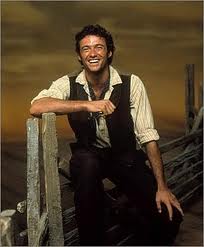
And then I watched this theater version of Roger and Hammerstein's Oklahoma! He plays Curly.


I was floored by his performance. The man can act. It's seriously impressive how good he is when all the special effects are taken away. He brought out all the humor that's embedded in the lyrics of the songs and the situations they sing them in. You know the humor's there in the R&H original, but the guy who plays Curly in it just kind of stands there and smiles and sings. Jackman brings so much life and expression to Curly that Oklahoma! moves to a whole different level of entertainment. He can actually dance and he has this incredible voice. Here, jump a few seconds into the video and listen:


Would you expect that from the guy who's famous for playing a mutant with claws? I know I didn't. And it was so neat to discover this entirely different aspect of one of my favorite actors. It also got me thinking. Thinking about how there is so much more to people than we think and assume.

We summarize people all the time. "She's a writer." "He's an actor." We associate individuals with what we see as their primary role. And they are that person. But they're also more than that. They're a particular combination of experiences and history, virtues and vices, hopes and hurts, dreams and hidden talent. It's so easy to attribute traits to someone because those traits are normally associated with that role. And once that attribution is made, that's all we tend to perceive.

We forget how complex people are. We forget how many roles a single individual fills. We forget to wonder or care about people's pasts, even though their histories have made them who they are. We just assume they've always been the way they are, that it's just their personality to be optimistic or aggravating. We never think about the possibility that they have to fight for that optimism or that there's good reason for someone to be begging for attention.

It's so obvious, too. We all know, intellectually, that people are complicated. We all know that there's a wealth of backstory for every single person on the planet. We know that there's more to people than first impressions. And yet we continue to put people into nice, neat little categories and expect their behavior to be consistent with the status we label them with.

I think that's what made discovering Hugh Jackman's musical talent so exciting and fun. He doesn't just fit into the hot-shot-actor/famous-person box any more. Not neatly, anyway. He's now actor, stage performer, and singer. He's so much more interesting now. And I think everyone is like that.

They're more. They're more than we expect or anticipate. They're more than we assume and are capable of more than we assume.

I think, at least in part, the revelation of that more is what makes life interesting. It makes life not just a grand adventure, but an adventure of character proportions. What do you think?